

Introduction to the working principle of thermal mass flow meters
Release time:
27 Jul,2022
Summary
What is a thermal mass flow meter?
Thermal mass flow meters (TMF), originating from the United States, are generally used for gas measurement in high-precision, trade settlement, or difficult-to-measure environments. Compared with traditional instruments, thermal mass flow meters have many advantages in measurement accuracy and maintenance, and are widely used in various industries such as thermal power, chemical industry, and oil and gas. Since being introduced to the general factory, it has performed well in gas flow measurement and has certain applicability.
A thermal mass flow meter is a thermal pneumatic instrument used to measure and calculate the temperature of fluid media. It is mainly composed of a differential pressure transmitter, an electromagnetic flow converter, etc. It can directly display or record flow rate, liquid level, and density values, and can be networked with a host computer to realize remote data transmission. Thermal mass flow meters are suitable for measuring the average temperature rise of working media in various viscous systems such as steam and air, such as feeding in petrochemical production, powder in dust removal pipelines, coal slurry pipelines, etc. Thermal mass flow meters have a simple structure, are easy to maintain, and can be installed and used without standard parts, so they are widely used in various fields of the national economy.
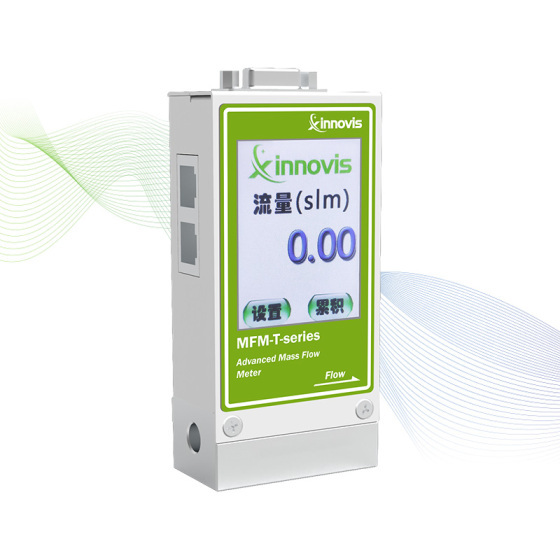
Working Principle of Thermal Mass Flow Meter
A thermal mass flow meter is a pipeline filled with a material such as metal or other material with high density and good pressure conductivity as a temperature measuring medium. When the measured medium passes through, due to the electrostatic induction phenomenon caused by the obstacle, a short-lived tiny potential difference is generated between the probe and the lining. These potentials change periodically with the change in the diameter of solid particles in the detected fluid. This oscillating signal caused by the transmission and conversion of the electric field is called frequency (also called pulse); level information can be obtained by amplifying this signal and recording it with special instruments.
Advantages of Thermal Mass Flow Meters
(1) Easy installation, diverse structure, insertion and pipeline installation, easy disassembly, simple operation, applicable to high-temperature occasions and corrosive environments. The all-metal structure ensures the long-term stable operation of the sensor in harsh environments.
(2) There are no moving parts, reducing measurement errors caused by dirty media or media particle blockage. The integrated design eliminates the need for additional instruments, reducing maintenance difficulty and preventing the influence of media leakage.
(3) A platinum RTD sensor is used, and a mass balancer is used in the sensor to balance the mass of the two RTDs, so that the mass flow rate of the medium can be accurately measured even when the temperature, pressure, and density change.
(4) High precision, high repeatability, no temperature and pressure compensation required. The directly measured fluid mass flow rate does not require temperature and pressure compensation. The accuracy can reach 1% fs, and the repeatability is generally around 0.05%. It can be used for trade settlement.
(5) Sensitive to small flow measurement, strong overload capacity, and large range ratio. When the actual flow rate is much higher than the full scale, a corresponding alarm will be issued, which will not damage the instrument.
More News

Tel: 400 006 6550
Office Address: 12F, Building I, International Innovation Park,
177 Songling Road, Laoshan District, Qingdao, Shandong, China